

May 2025//Archive #5
May thoughts and books read- What does it mean to get better? Depression, pain, therapy, craft, the body, and Palestine.

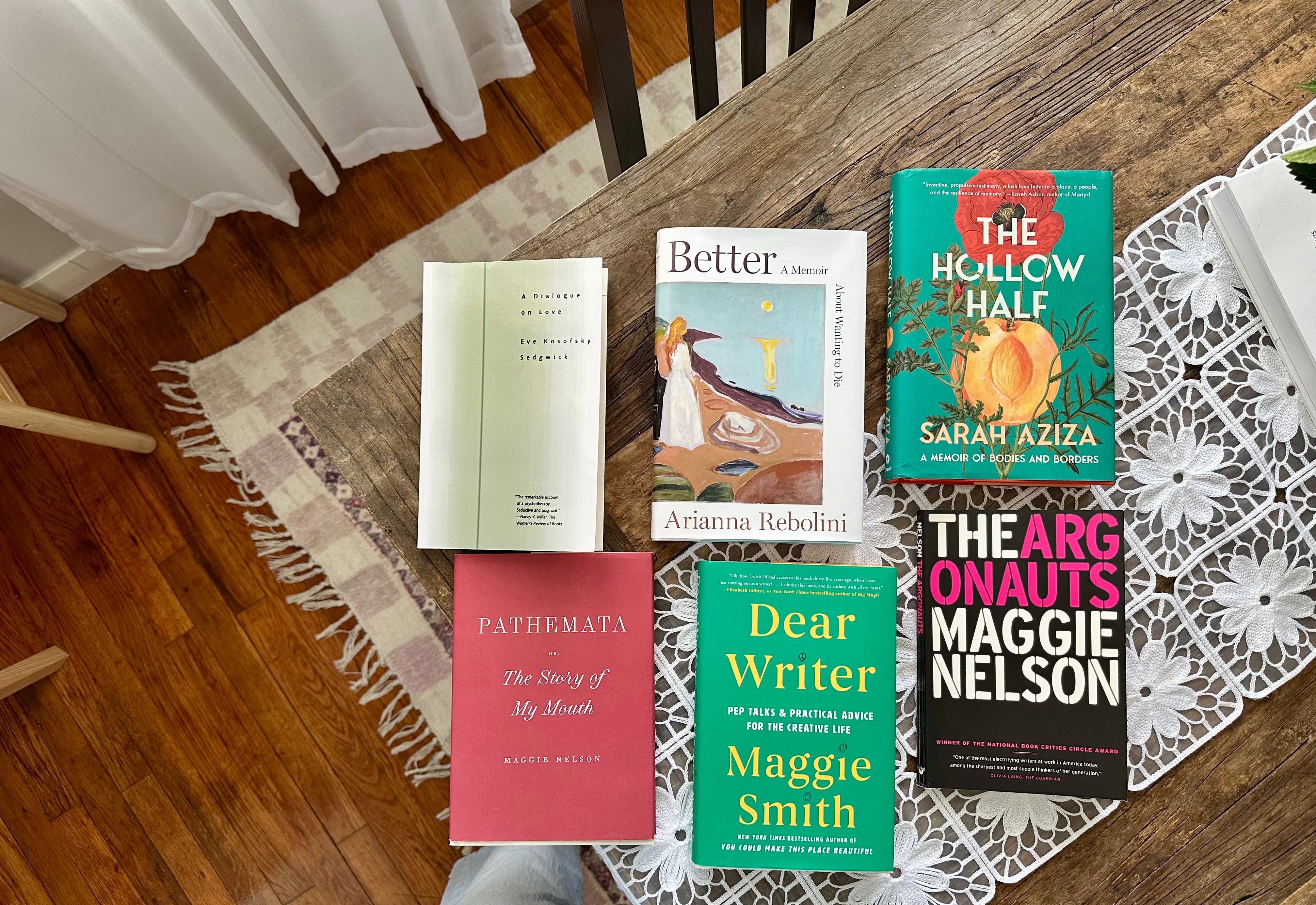
What does it mean to get “better?” This month's books explored depression and its deep-rooted effects on life and family, how getting better shouldn’t and often can’t be the goal for a full, rich life. A tiny memoir about physical pain and navigating an inability to find relief while a pandemic rages, loved ones die, and a writer questions the function of a mouth as a writer and weaver of words. Another memoir, a dialogue between a patient and their therapist, explores self-discovery and the excavation of the interior to create art through therapy. A book about the craft of writing and “bettering” your own. And lastly, a memoir about the loss of a body and a country, of hoping for a better future for Palestine.
If this is your first time here, welcome! Here is a bit about how my monthly wrap-ups work and the inspiration behind them. I try to keep these relatively short with an overview and review of the book, some media mentioned like artwork, other books, etc., and a quote synthesizing the book.
Better: A Memoir About Wanting to Die by Arianna Rebolini is an intimate memoir of depression and its generational hold on a family and her growing fears of passing her long-rooted desire to die to her young son. After a stint in a psychiatric ward, Rebolini feels “better,” although the desire to die, knowing it is always an option, never leaves her. So she turns to journals, memoirs, and writers of famous suicides. Although she has thought about and nearly attempted suicide, she desperately wants to understand what happens between wanting to end your life and doing it. Initially, Rebolini hopes to get “better,” it’s the narrative doctors and our culture work towards —she even believes that with the right therapy, medication, or life, she will be better and no longer be a depressed or suicidal person, but that doesn't happen. What does it mean to never get better? To try and stay alive? To know the desire to die is always around, and how much of that feeling is due to societal factors often out of our control? The systemic issues of a pandemic, capitalism, race, access to care, and a family history. I appreciated this personally investigative memoir and Rebolini’s acceptance of living side by side with her depression, never striving for the impossibility and societal implications of “better” but what being better can look like for each individual with depression.
I’ve lived the entirety of my adult life within the presumption that only when I’ve definitively rejected suicide—when I’ve confidently, unequivocally decided I’m committed to life—will I be able to allow myself to stop worrying about it. But maybe that’s never going to happen. Is the disposal of that ambivalence a requirement of recovery?
The Argonauts by Maggie Nelson. I’m embarrassed to say that this book has been sitting on my shelf since 2017 and has been mentioned in nearly every other book I’ve read over the last two years. Perhaps I should have read it eight years ago for its impact to land a bit more and then to witness its rippling effects throughout the literary and theoretical canon. Nelson is, without a doubt, “big-brained energy,” and I enjoyed The Argonauts, but it didn’t rock my world the way I imagined it would—perhaps it all had to do with timing. It’s about identity, love, gender, the body, the changes a body undergoes, and the ways a family can change and be redefined. I did find Nelson's observations of her own body changing through pregnancy and her birth experience to be the most interesting part of the book, and I’m sure that had to do with it being an experience her body was actively having as compared to her partner Harry Dodge’s transition which Nelson writes about but is not experiencing. I'm glad I finally read it, and once I finished, I felt even more prepared for the two books I picked up next.
On the surface, it may have seemed as though your body was becoming more and more “male,” mine, more and more “female.” But that’s not how it felt on the inside. On the inside, we were two human animals undergoing transformations beside each other, bearing each other loose witness. In other words, we were aging.
Pathemata or, The Story of My Mouth by Maggie Nelson. This Maggie Nelson was 100% for me! I appreciated The Argonauts and how Nelson weaves theory throughout, but Pathemata reads like a memoir, although not a linear one. I enjoyed being in Nelson’s mind and body, similar to the moments I preferred with The Argonauts. Nelson begins with a stunning first page that reads like a poem. We wake up alongside Nelson before the rest of her house and is moved from bed because of the pain in her jaw, one she describes as feeling as though it has “survived a war." She then weaves her way through 70 pages analyzing her pain, seeking relief from anyone, navigating the pandemic in uncomfortably familiar ways, the loss of a dear mentor, dreams, and the role of the mouth for a writer. At times, the book is disorienting, as it isn’t always clear from section to section whether you are in reality or a dream—however, I felt that this ambiguity worked well with the overall theme of pain and the often uprootedness that accompanies it.
Sometimes I wonder what I would have thought about all these years, if I hadn’t spent so much time thinking about the pain. Then I remember that I’ve thought about a lot of other things as well.
A Dialogue on Love by Eve Kosofsky Sedgwick was the book club pick for the bookstore where I work, and it was fitting that we read it as Maggie Nelson refers to it and Sedgwick quite often in The Argonauts. Sedgwick is another writer and thinker who is referenced in many of the books I have read recently, and I’m glad I finally had the opportunity to read a book by her. This was an excellent place to start, and if you haven’t read Sedgwick before, I suggest beginning here! In this memoir, Sedgwick begins therapy for depression after breast cancer treatment. What follows are a mix of conversations between her and her therapist, Shannon, who is male (yes, this seems important to mention), poetry, and Shannon’s notes. The book offers a raw and unflinching look into a woman’s interior life, exploring themes of family history, love, pleasure, death, and life. The writing is poetic, an archive of a transparent experience not many would be able to write, much less share with the world. This book made me rethink my relationship with my own therapist and question if I’m doing therapy wrong.
Shannon and I agree: feeling “not together” is part of the bobbing-like-a-cork strategy. Temporarily disarticulating my different worlds from each other, my faculties, my past from present from future.
Dear Writer by Maggie Smith is a craft book I listened to on audio and ended up buying a copy of. It's an excellent resource for writers, poets, and artists of all kinds, offering creative insights from mining the interior, motivational pep talks, and practical advice on topics such as titling works, submitting, and handling rejection. She breaks down creativity into ten essential elements: attention, wonder, vision, surprise, play, vulnerability, restlessness, connection, tenacity, and hope. The end of each chapter includes generative writing prompts and lists of writers' work to help inspire. At times, Smith is a bit too sentimental in her attempts to connect with the reader, as though motivating them through the page—that's just a personal pet peeve. Overall, this would be a valuable addition to your craft book collection.
The Hollow Half by Sarah Aziza. I had the privilege of seeing Aziza in conversation with Kiese Laymon at Class Bookstore here in Houston on Independent Bookstore Day, and it was a stunning and intimate conversation surrounded by an incredible group of people. After hearing Aziza, I knew this memoir was going to be something special and also difficult to read. It focuses on Aziza’s near-death experience with an eating disorder in 2019, being hospitalized, and entering the pandemic shortly after, where she struggles to survive and begins excavating her family history in Palestine. As the daughter and granddaughter of Gazan refugees, she comes to terms with her Palestinian American heritage. This is a phenomenal book, not only for Aziza's handling of personal, bodily, and family history, but also for the way she plays with time through dreams and poetic writing, as well as the memoir's structure. I can’t recommend this enough, and it will live on my all-time favorite memoirs shelf.
Resilience as allegiance to a future divorced from present pain. Sometimes, this is a necessary time travel. There are years we survive only if we cheat. But our bodies are a bargain we break at our own risk.
What did you read and love this month?
Did you notice any interesting themes?
Any books you finally picked up that had been on your shelf for over five years?
Lastly, a few music videos I have loved recently, all with movement and dance! Thanks for being here!
I just read “don’t let me be lonely” by claudia rankine and picked up “citizen” last night. DLMBL is so incredible that I re-read it immediately. argonauts was my first maggie nelson & I think because I had ZERO context for it I kinda loved the feeling of being lost; but I too connected the most with the last 20ish pages of her birth experience paralleled with harry’s experience, in his own words, of his mothers death. I’m reading “on freedom” by nelson now & am also loving the challenge of it. I’ve never heard of “the hollow half” but it will absolutely be going on my list 💫